Tenant or Owner
The choice that decides India's next decade
By Aynstyn · · 13 min read
Picture a large shed on the outskirts of a district town. It draws power from the state grid. It draws water from an aquifer the surrounding farms also draw from. It employs perhaps forty people, mostly security and facilities. Inside, racks of imported silicon think expensive thoughts on behalf of a company headquartered eleven time zones away.
The land is ours. The power is ours. The water is ours. The intelligence is not. And the value created by that intelligence accrues, almost entirely, somewhere else.
That is one version of India in 2035. It is not a dystopia it is a perfectly respectable middle-income outcome, and plenty of countries have settled for it. It is the outcome you get by default.
The other version requires something harder.
The one sentence
India's next leg of growth has to come from Indians who build things people pay for not from Indians who get hired.
Everything below is an argument for that sentence, and an honest accounting of what stands between us and it.
India is a mixed economy.
The Preamble to the Constitution still calls India socialist. Between 1950 and 1991 the state genuinely did occupy the commanding heights licensing, public sector monopolies, controlled prices. That India is gone. What replaced it after the 1991 liberalisation is a market-led economy with a large and strategically active state.
The state still runs or dominates railways, a substantial share of banking, defence production, nuclear power, and much of the coal and oil chain. It still writes cheques that reshape entire industries - ₹76,000 crore for semiconductors, ₹10,000 crore for a fund-of-funds for startups. But price signals, capital allocation, and the overwhelming bulk of employment are private.
The mix is roughly market economy with an industrial-policy state, not socialist economy with a private sector allowed in. That distinction matters, because it tells you where the growth has to come from. It is not going to come from the government hiring people.
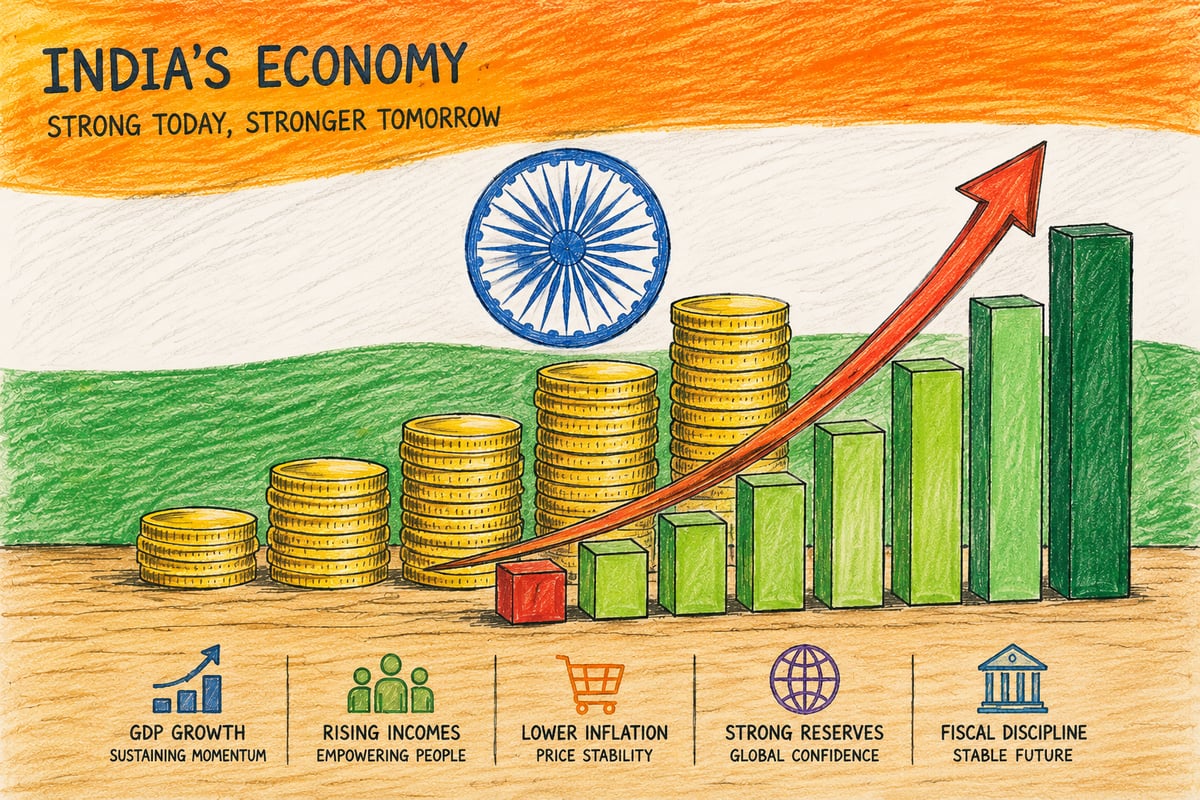
For scale: India's nominal GDP for FY 2025-26 is estimated at around ₹357 lakh crore, roughly $3.96 trillion, growing about 7.4% in real terms. India overtook Japan in 2025 to become the world's fourth-largest economy by nominal GDP. FDI equity inflows hit ₹5.17 lakh crore in FY26, up 23% year on year. India climbed seven places to 38th on the 2025 Global Innovation Index.
The macro picture is good. The micro picture is where the problem lives.
The scoreboard
Here is what India's economy actually looks like at ground level, as of 2026.
Total employed: about 61.6 crore people. (Periodic Labour Force Survey, 2025)
How they work:
- Self-employed: 56.2%
- Regular wage or salaried: 23.6%
- Casual labour: 20.2%
Where they work:
- Agriculture: 43.0%
- Manufacturing: 12.1%
- Construction: 12.0%
- Everything else, mostly services: the remainder
Government jobs. There is no single clean official number, which is itself telling. Central government civilian sanctioned strength sits around 40 lakh posts with roughly 31 lakh filled - a standing vacancy of nearly a fifth. Add state governments, public sector enterprises, and local bodies and the credible range runs from about 1.8 crore on a narrow definition to around 3.9 crore on a broad one that includes teachers, health workers and municipal staff.
Either way: government employs somewhere between 3% and 6% of India's workforce. Every year, tens of millions compete for a few lakh of these positions.
Private formal jobs. EPFO has been adding roughly 1.3 to 1.45 crore net subscribers a year the strongest formalisation run in India's history. But zoom out: of the 23.6% in regular salaried work, PLFS found 58% had no written contract, 47% no paid leave, and 53% no social security. About 85% of India's total workforce remains informal.
Manufacturing. Over 7.83 crore enterprises are registered across the Udyam platforms as of February 2026, up from 0.79 crore in FY22 a formalisation surge, not a manufacturing surge. Look at the composition: 98.9% are micro. Only 37,042 enterprises in the entire country qualify as medium. Manufacturing contributes roughly 17% of GDP and employs 12.1% of workers.
India has enormous numbers of tiny firms and almost no mid-sized ones. That missing middle is the single most under-discussed structural fact in the Indian economy.
Startups. More than 2.40 lakh DPIIT-recognised startups as of mid-2026, spread across 669 districts. FY26 alone added over 55,200 a record, up 51.6% year on year. They've created about 23.36 lakh direct jobs and filed over 19,400 patent applications. The broader ecosystem, per Tracxn, runs to roughly 6.87 lakh companies, of which about 34,400 are funded, having raised around $620 billion cumulatively, producing 89 unicorns.
Read those last two numbers together. Roughly 6.87 lakh startups. Eighty-nine unicorns. And 23 lakh jobs across the whole recognised ecosystem - less than half of what the IT services industry alone employs.
Multinationals. India hosts 2,117 Global Capability Centres operating across 3,728 units, employing about 2.36 million people and generating an estimated $98.4 billion in FY26 (NASSCOM–Zinnov). Around 506 of the Forbes Global 2000 now have India operations. By 2030 the projection is 2,100–2,500 centres, 2.5–2.9 million people, and $100–110 billion.
This is genuinely impressive. It is also, precisely, the tenant model at its most sophisticated.
The number that should worry you
India's technology industry is projected at $315 billion in FY26, with $246 billion in exports IT services $149bn, engineering R&D $63bn, BPM $59bn, software products $23bn, hardware $21bn. Growth: 6.1%.
Now the other number. Sector headcount reached about 59.5 lakh, a net addition of roughly 135,000 jobs - 2.3% growth.
Revenue up 6.1%. Headcount up 2.3%.
That gap is the whole story. It is not that Indian software exports are about to collapse Goldman Sachs projects India's total services exports reaching around $800 billion by 2030, up from $340 billion in 2023, roughly 11% of GDP. Services exports already crossed $348 billion in the first ten months of FY26.
The revenue is fine. The jobs per dollar are not.
For thirty years India's deal with the world was: we supply capable engineers at a fraction of the cost, you supply the demand. That deal converted headcount into foreign exchange, and foreign exchange into middle-class households in Pune, Hyderabad, Coimbatore and Kochi.
AI is quietly renegotiating that deal. As software gets cheaper to produce, more of it gets produced demand genuinely expands. But the labour required per unit falls faster. NASSCOM notes AI revenue at $10–12 billion and over two million professionals upskilled in AI, with 200,000–300,000 in advanced skills. That's adaptation. It is not the same as growth in employment.
India's software export engine will keep earning. It will stop absorbing. Something else has to absorb seven to ten million young Indians entering the labour market every year.
Data centres: the tenant trap
The obvious candidate is AI infrastructure. As of January 2026, India has about 271 data centres, with installed capacity around 1.5–1.7 GW, projected to reach 4.5–6.5 GW by 2030 some forecasts go to 12 GW. India added 387 MW of IT capacity in 2025, more than double the 191 MW added in 2024. The announced investment pipeline runs to roughly $90 billion, with AWS, Microsoft and Google alone accounting for about $67.5 billion. Google has committed $15 billion to an AI hub in Visakhapatnam. Adani has announced $100 billion over a decade. OpenAI and Tata are building toward a gigawatt.
Now the physics. Indian data centres currently consume around 150 billion litres of water a year, projected to reach 359 billion litres by 2030 — with more than half of facilities sitting in water-stressed regions. Electricity demand from the sector is projected by the Ministry of Power to rise from about 1 GW today to 13.56 GW by 2031-32.
And here is the sentence that should be taped to a wall somewhere in Delhi: India generates nearly 20% of the world's data and holds 3–4% of the world's data centre capacity.
That gap is either the biggest opportunity of the decade or the biggest giveaway of the decade, depending entirely on who owns what.
A data centre employs very few people relative to its capital and resource footprint. Hosting is not sovereignty. If India supplies the land, the water, the power and the tax holiday, and a foreign hyperscaler supplies the chips, the models and the customer relationship, then India has become a landlord in a business where the tenant captures nearly all the value.
Landlording is not a bad business. It is just a permanently capped one.
Energy: the actual bottleneck
Intelligence gets cheap when energy gets cheap. That is the real constraint under everything above.
India has moved faster here than almost anyone gives it credit for. Total non-fossil installed capacity reached 283.46 GW as of 31 March 2026 274.68 GW renewable plus 8.78 GW nuclear against total installed capacity of roughly 542 GW. That means over half of India's generation capacity is now non-fossil, a Paris Agreement commitment hit five years early. FY26 saw a record 55.3 GW of non-fossil addition, nearly double the previous year. Solar alone crossed 150 GW. India now ranks third globally in renewable capacity. The 2030 target is 500 GW.
Manufacturing has followed: solar module capacity went from 2.3 GW in 2014 to roughly 172 GW in 2026; cell manufacturing from zero to about 27 GW.
But look one layer deeper into that supply chain and the picture thins out. Modules, yes. Cells, increasingly. Wafers, ingots and polysilicon largely still imported. We have localised the last mile of a supply chain whose first mile still runs through someone else's country. The same vulnerability applies to battery cells, and to the rare earths and critical minerals underneath both.
Green energy solves the carbon problem. It does not automatically solve the sovereignty problem. Those are two different problems and India is much further along on the first than the second.
Semiconductors: where sovereignty is actually decided
Under the India Semiconductor Mission, 12 manufacturing units have been approved with cumulative investment of about ₹1.64 lakh crore across six states thirteen if you count the Bhiwadi facility approved under SPECS. Three are commercially operational: Micron's ATMP unit at Sanand, inaugurated 28 February 2026; CG Semi; and Kaynes Semicon, inaugurated 31 March 2026.
The centrepiece is the Tata Electronics–PSMC fab at Dholera: ₹91,000 crore, 300mm wafers, 50,000 wafer starts per month at 28nm–110nm, first silicon targeted for December 2026 and full commissioning by 2028.
Here I want to push back gently on a common framing including one I suspect you hold.
Sub-7nm is not the measure of semiconductor sovereignty, and chasing it first would be a mistake.
The 28nm node is the workhorse of the modern physical world: automotive controllers, industrial microcontrollers, power management, display drivers, IoT. By volume, most chips made on earth are mature-node chips. A country that can make them controls its own automotive, defence, industrial and appliance supply chains. That is real sovereignty, and it is the sovereignty India can plausibly hold by 2029 the government's stated target is domestic capability covering 70–75% of domestic applications by then.
Leading-edge logic matters for exactly one thing at national scale: AI accelerators. And there, note where India already sits. Roughly 20% of the world's semiconductor designers are Indian. Qualcomm has completed 2nm tape-outs designed entirely in its Indian centres fabricated at TSMC in Taiwan. Design accounts for up to 50% of value addition in the semiconductor stack.
So India already owns half the value chain at the frontier. What it lacks is the fab. Semicon 2.0 sets a roadmap toward 3nm and 2nm nodes and a top-five ambition by 2035, which is the right sequencing: mature node now for industrial independence, design leadership held and deepened, advanced node as a decade-long build rather than a leapfrog fantasy.
The honest version of your worry survives, though, and it's the important one. If India ends up hosting the compute but importing the silicon and licensing the models, then the data centre boom is an extraction event with an Indian address on it. The counter to that is not a 2nm fab by 2030. It's owning enough of design, enough of mature-node fabrication, enough of energy, and, critically, enough of the products and models running on top, that the stack has Indian value at multiple layers rather than Indian land at one layer.
So what actually boosts the economy?
Everything above converges on a single answer.
Not government jobs 3 to 6% of the workforce and structurally incapable of scaling.
Not IT services employment - the revenue survives, the headcount plateaus.
Not GCC expansion alone - excellent, high-paying, and fundamentally someone else's P&L.
Not data centre construction by itself - capital-intensive, labour-light, and value-light unless you own more of the stack.
The only mechanism that has ever moved an economy of this size into the next tier is a large population of people who create products and services that other people voluntarily pay for. Domestically first, then internationally.
Because here is the thing underneath all economics: everything in this world is driven by value. Value delivered either as a physical product you can hold, or a service you cannot. There is no third category. GDP is just the sum of value people were willing to pay for. Employment is just what happens when creating that value takes more than one person.
Look at the numbers again with this lens. 56.2% of India's workforce is already self-employed. But self-employment in India mostly means subsistence a vegetable cart, a two-person tailoring shop, an own-account farm. It is survival activity, not value creation at scale. That's why 98.9% of registered enterprises are micro and only 37,042 are medium.
India does not have a shortage of self-employed people. It has a shortage of empowered ones.
What "empowered" actually means
This is the part that no policy document can produce, and it's the part that matters most.
An empowered entrepreneur is not someone with capital. It is someone who does not stop.
Someone who ships a bad first version and does not read it as a verdict on their worth. Who takes the criticism, extracts the signal, discards the noise, and ships version two on Tuesday. Who holds a vision of what the company is for and lets everything else the features, the pricing, the hires, the pivots be negotiable in service of it. Who learns through the doing rather than in preparation for it.
The failure mode is almost never a lack of ideas. India has no shortage of ideas. The failure mode is discouragement the founder who was told by a family member, a bank manager, a first customer, or an anonymous comment that this was never going to work, and who agreed.
Creation is genuinely hard. It demands sharpness, intellectual honesty, and grit sustained past the point where the feedback stops being flattering. Most people are never taught that this difficulty is normal and survivable. They experience the difficulty, conclude they are not built for it, and go back to preparing for an exam.
That is the loss. Not the failed startup the founder who never started because nobody told them the hard part is supposed to feel like this.
Grit is not a personality trait you are born with. It is a norm you absorb from the people around you. Which means it can be taught, and it is taught fastest by community.
What an ecosystem owes a builder
Capital, yes - and India has built more of that than people acknowledge. FoF 2.0 carries a ₹10,000 crore corpus, now extended to deep-tech, micro-VCs, and tech-driven manufacturing. Nearly 40,000 startups are onboarded onto GeM. The 2026 recognition framework doubled the turnover ceiling to ₹200 crore and created a formal deep-tech category with a 20-year window.
But capital is the easy part. The harder inputs:
Distribution. A first customer is worth more than a first cheque. Public procurement, corporate pilot programmes, and market access do more for a young company than another funding round.
Compressed feedback loops. The bottleneck for most Indian founders isn't money, it's the eighteen months spent learning something a practitioner could have told them in an afternoon.
Peers who are also building. Not mentors delivering advice from a stage. Peers three months ahead, in the same fight, on the same week.
A norm that failure is data. The genuine constraint on Indian entrepreneurship has never been regulatory. It has been social. Ninety-nine percent of ventures will not become unicorns, and an ecosystem that treats that as shameful will get very few attempts.
Why we built Aynstyn
The default way to learn something in India is to enrol in a course. Watch the videos. Take the quiz. Get the certificate. Discover you cannot do the thing. Enrol in another course.
It is a loop that feels like progress and produces almost none. Its central deceit is that understanding precedes doing that you become capable by consuming enough explanation.
You don't. You become capable by building something badly, seeing exactly where it breaks, and fixing it. That is the only mechanism there has ever been.
At Aynstyn we've built the MAPPT framework(mindset, analytics, prepare, practice, test) around that mechanism: learning organised around doing rather than around watching. Practical from the first hour. Structured so the loop between attempting something, failing at it, and understanding why closes in hours instead of semesters. Built for people who intend to make something, not collect evidence that they studied it.
Because the constraint on India's next decade is not capital, and it is not talent, and it is not policy. It is the number of Indians who have been shown concretely, in their own hands that they can take an idea and make it real.
Get that number high enough, and the rest resolves itself. The products get built. The mid-sized firms fill in the missing middle. The exports diversify beyond one sector. The data centres serve Indian models built by Indian companies rather than the reverse.
Tenant or owner. That's the choice. And it doesn't get made in a policy document - it gets made a few hundred thousand times, one builder at a time.