What Is Holding India’s Growth?
A near-zero-risk culture can produce survivors, but it cannot produce enough inventors.
By Aynstyn · · 9 min read
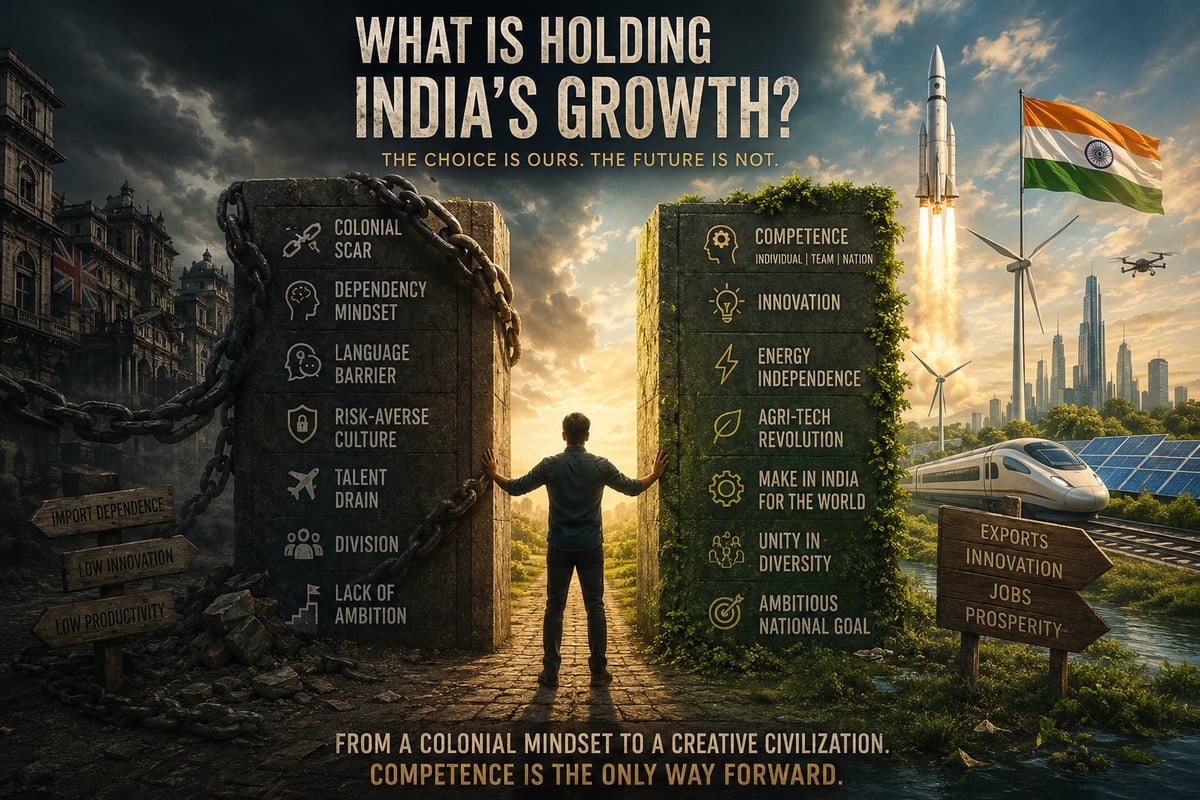
India does not have a talent problem. India has a competence problem.
That may sound uncomfortable, but it is the truth we need to sit with. We are a country with one of the largest youth populations in the world, a massive diaspora, a strong IT services base, deep civilizational memory, good rainfall in many regions, abundant sunlight, and a natural instinct for survival. Yet, we are still not serving the world at the scale we are capable of.
The real question is not, “Can India grow?”
The real question is, “What is holding India’s growth back?”
The Colonial Scar and the Conservative Mindset
India came out of colonialism wounded. Colonialism did not only take wealth; it left behind a psychology. It made us careful, suspicious, conservative, and hesitant. After independence, the country needed healing. We had to rebuild institutions, recover dignity, and decide what kind of nation we wanted to become.
In that period, the Congress-led foundation of self-reliance made sense. A newly independent country could not blindly open itself to the same global forces that had once exploited it. Self-reliance was a protective instinct.
But protection, when stretched too long, can become hesitation.
India remained cautious about foreign capital for many years. China, on the other hand, opened itself more aggressively to global manufacturing and foreign direct investment. The difference compounded. India’s net FDI inflows were only around $0.074 billion in 1991, rising to about $3.6 billion by 1997. China, by contrast, moved from an annual average of around $2 billion in the 1980s to just over $40 billion annually between 1996 and 2000.
That gap was not just money. It was factories. It was supply chains. It was technology transfer. It was confidence. It was the habit of building for the world.
India healed slowly. China industrialized aggressively.
And the world rewarded speed.
English Became Our Operating System
The second problem is deeper and more psychological.
India continued to operate through a western dialogue system. English became the language of power, education, law, business, aspiration, and upward mobility. It gave India access to the world, but it also created a split inside the country.
- Our ambition spoke in English.
- Our emotions spoke in regional languages.
- Our governance tried to speak in Hindi.
- And our people were divided between all three.
English helped us enter global markets, especially IT and services. But it also meant that knowledge, opportunity, and confidence became unevenly distributed. A child who could think well but could not express that thinking in English was often treated as less capable. That is not a talent failure. That is a system failure.
Hindi did evolve, but largely inside government and cultural spaces. Regional languages carried identity and emotion, but not enough frontier knowledge in science, technology, business, design, and innovation. We called many things “swadeshi,” but we did not always convert swadeshi into world-class capability.
A language becomes powerful when it carries the future.
For too long, our languages carried memory while English carried opportunity.
Capital Was Scarce, and Risk Became a Sin
India also suffered from a severe lack of capital. For many families, taking risk was not considered courageous; it was considered irresponsible. The safest path became the most respected path: government job, stable salary, low-risk career, land, gold, savings.
This created a near-zero-risk culture.
A near-zero-risk culture can produce survivors, but it cannot produce enough inventors.
Innovation requires the ability to fail, rebuild, and try again. But in India, failure was often treated as a personal stain. People did not simply lose money; they lost social standing. Families did not ask, “What did you learn?” They asked, “Why did you take such a risk?”
- So talent became cautious.
- Energy became defensive.
- Ambition became private, not national.
We Exported Talent Because Talent Became Our Resource
India does not have the natural resource advantage of an oil-rich country. We do not sit on a Saudi-style oil reserve. In fact, India imports a major share of its crude oil requirement, with import dependence around 87% in 2022–23, and recent estimates putting oil import reliance above 90%.
So India made talent its resource.
And talent did what resources usually do: it got exported.
Indian doctors, engineers, founders, researchers, coders, managers, and operators went to the US, the Gulf, Europe, Canada, Australia, and other parts of the world. This created pride, but also pain. India has one of the world’s largest diasporas, and remittances touched around $137 billion in 2024, making India the top remittance recipient in the world.
This is both a strength and a warning.
The strength is that Indians can succeed anywhere.
The warning is that many Indians had to go elsewhere to fully succeed.
A country should not only export its people or talent. It should also export its products, platforms, machines, ideas, energy systems, agricultural technologies, medicines, chips, materials, and intellectual property.
If talent leaves and products do not return, then the country becomes emotionally proud but economically dependent.
No Unified Ambitious Goal
Another major gap has been the absence of a strong, ambitious, unifying national goal.
We have had slogans. We have had schemes. We have had political movements. We have had emotional mobilization. But we have not consistently given the common citizen a frontier-level mission that says:
This is what India must build.
This is what every student, founder, engineer, farmer, scientist, teacher, and policymaker must contribute toward.
Today, religion is being used as a unifying force. But religion alone cannot build semiconductors. It cannot solve the energy problem. It cannot create agricultural intelligence systems. It cannot manufacture aircraft engines. It cannot build world-class universities. It cannot reduce import dependence. It cannot make India a product nation.
Faith may give identity.
But competence builds civilization.
The danger of idealizing anything too much is that it stops us from asking hard questions. When a country begins to worship identity more than capability, it starts confusing pride with progress.
And pride without production is fragile.
The IT Comfort Zone Is Also Under Threat
For the last few decades, IT services became India’s growth engine. It gave millions of Indians jobs, global exposure, salaries, confidence, and middle-class mobility. The Indian technology industry is now worth hundreds of billions of dollars and employs millions of people.
But we must be honest: the old IT model is under pressure.
AI is already changing coding, testing, support, documentation, customer service, analytics, and routine software delivery. It may not replace every IT worker immediately, but it is already changing the value of basic execution. The world will need fewer people who only follow instructions and more people who can design systems, solve ambiguous problems, use AI deeply, and build products.
India’s tech workforce is large, but large is not enough.
If AI reduces the need for routine IT work, then India cannot depend forever on being the back office of the world. We have to move from service execution to system creation.
The next frontier will not reward those who only code.
It will reward those who can imagine, architect, integrate, secure, scale, and own the outcome.
The Real Solution: Competence
So what is the solution?
The solution is competence.
Competence at the level of the individual.
Competence at the level of the team.
Competence at the level of the country.
We need to become healthier, sharper, more disciplined, more technically capable, more emotionally mature, and more ambitious. We need to stop celebrating only survival and start celebrating mastery.
At an individual level, competence means skill, fitness, clarity, communication, deep work, AI literacy, financial understanding, and courage.
At a team level, competence means trust, execution, product thinking, research, design, speed, accountability, and the ability to work across cultures.
At a country level, competence means choosing big missions and staying with them for decades.
Where Should India Build Next?
India needs to ask a simple question:
What can we build for the world that the world cannot ignore?
Agrarian technology is one answer. India has rainfall, sunlight, agricultural memory, and a massive farming base. Agriculture still employs over 40% of India’s workforce. But the future of agriculture is not only farming; it is precision farming, soil intelligence, water management, agri-robotics, climate-resilient crops, supply-chain intelligence, food processing, and farmer-centric financial systems.
Energy is another answer. India has around 300 sunny days in many regions and enormous solar potential. Yet we remain deeply dependent on imported energy. This is a contradiction waiting to be solved.
We should not only install solar panels. We should build the entire energy stack: storage, grid intelligence, battery chemistry, green hydrogen, advanced nuclear research, plasma research, and long-term fusion science. Plasma or fusion breakthroughs may look far away, but every serious civilization needs a frontier mission. If a billion people direct even a fraction of their thinking toward solving energy, breakthroughs become more likely.
Energy independence is not only an economic goal.
It is a civilizational goal.
Difference Must Become Our Advantage
India is diverse in language, religion, food, geography, culture, and thinking. This diversity can either become friction or force.
Right now, too often, it becomes friction.
States fight over language. Communities fight over identity. Political groups fight over memory. We waste national energy on proving who belongs more, who suffered more, who is more authentic, who is more Indian.
But no country can fight within and grow at its full potential.
The United States grew not because it had no internal conflict, but because it became a magnet for talent. Different cultures, different thinking models, different scientific traditions, and different ambitions came together and created companies, universities, technologies, and industries that served the world.
India does not need to copy the US. But India must learn one lesson clearly:
Talent must matter more than identity.
Competence must matter more than background.
Contribution must matter more than symbolism.
If India can turn difference into collaboration, the same diversity that slows us down today can become the engine that moves us forward tomorrow.
We Must Serve the World With Products
India’s trade numbers show the urgency. In FY 2025–26, India’s total exports were estimated at around $860 billion, while total imports were around $979 billion. Merchandise imports alone were about $775 billion, compared with merchandise exports of about $442 billion, creating a merchandise trade deficit of over $333 billion.
This tells us something simple.
We are still buying too much of what others build.
Unless India serves the world with products, platforms, deep technology, energy systems, agricultural innovation, and advanced manufacturing, we will continue to feel the pressure of dependence.
A country becomes powerful when the world depends on what it produces.
Not only when its people work hard.
Not only when its culture is old.
Not only when its population is large.
But when its products, systems, and ideas become necessary to others.
The Vertical Step
India does not need small arguments now. It needs a vertical step.
A vertical step means moving from survival to creation.
From emotion to execution.
From identity to competence.
From service to product.
From brain drain to brain circulation.
From importing energy to solving energy.
From fragmented ambition to national mission.
From “Who are we?” to “What are we building?”
The future will not wait for India to resolve every internal contradiction. The world is moving into AI, energy transition, climate pressure, new manufacturing, synthetic biology, robotics, space, and advanced materials. If we keep fighting over small things, we will miss the large shift.
India’s growth is not being held back by lack of talent.
India’s growth is being held back by scattered talent, conservative risk culture, imported operating systems, internal division, weak product ambition, and the absence of a shared competence mission.
The way forward is not blind westernization.
It is not empty nationalism.
It is not religious idealization.
It is not nostalgia.
The way forward is competence.
- Build better individuals.
- Build better teams.
- Build better institutions.
- Build better products.
- Build better energy systems.
- Build better farms.
- Build better science.
- Build better ambition.
- That is how India grows.
Not by asking the world to respect us.
But by building things the world cannot ignore.