Who is the expert now?
The history of computing can be told as a single story: humans and machines slowly learning to understand each other. For most of it, the humans did the learning
By Aynstyn · · 7 min read
Who is the expert now?
For forty years, the expert in the room was the person who knew where the buttons were. Now the machine understands what we mean, and the buttons are disappearing. So what is expertise, when anyone can simply ask?
Every office used to have one. The person everyone walked over to when the software wouldn't behave. They knew the shortcut, the hidden menu, the exact order of steps. Nobody questioned their expertise, because nobody else could do what they did.
Here is the uncomfortable part: much of what made them an expert was not knowledge of the work. It was knowledge of the machine. They had learned to speak its language when most people hadn't.
That language is no longer needed. AI now understands ours.
The expert used to be the person who could speak the machine's language. Now the machine speaks ours. The expert is the one who knows what to ask for, and can tell when the answer is wrong.
This article traces how we got here, what the research says about who AI helps most, and what real expertise looks like once the language barrier is gone.
Who learned whose language
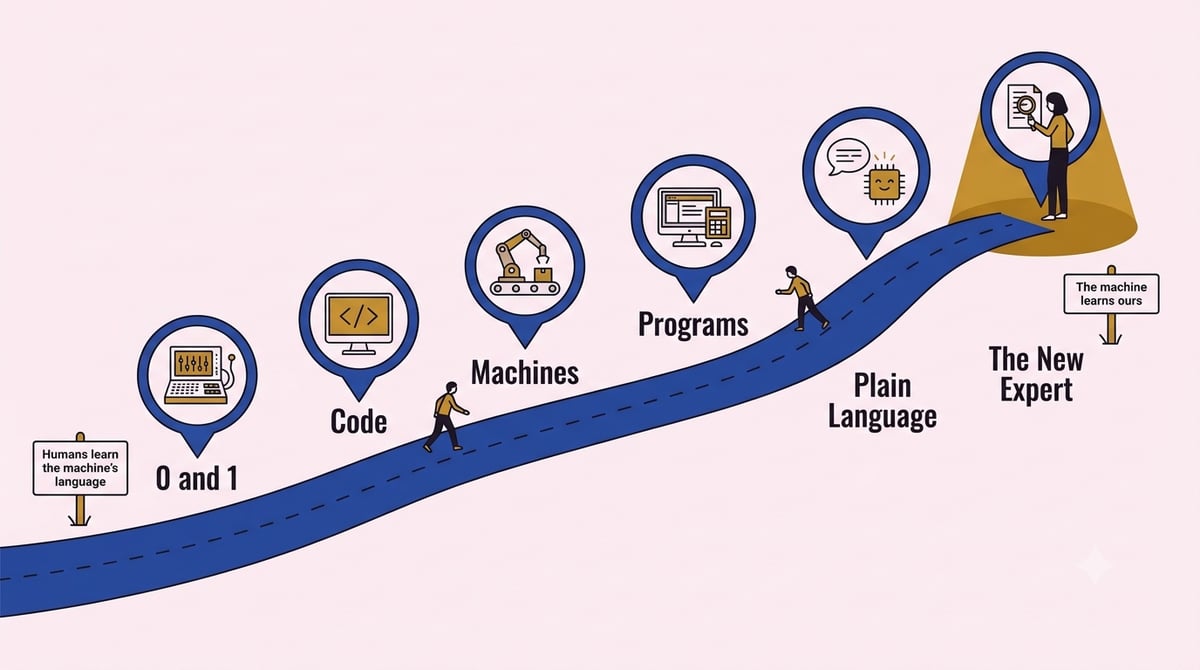
The history of computing can be told as a single story: humans and machines slowly learning to understand each other. For most of it, the humans did the learning.
- 1940s · 0 and 1The first computers only understood binary. Programming meant setting switches and plugging cables by hand. Only a handful of people on earth could talk to them.
- 1950s–70s · CodeProgramming languages gave us words the machine could translate. Still, you had to learn its grammar exactly. One misplaced character and nothing worked.
- 1970s–90s · MachinesComputers began controlling machines on our behalf: repeating an action a thousand times, watching safety sensors, running factory lines. The machine did the work; humans still gave precise instructions.
- 1986–2010s · ProgramsSoftware like Tally (1986) and Photoshop (1990) turned the computer into a workplace tool. Knowing a program deeply became a profession in itself. "Tally operator" and "Photoshop expert" went on résumés.
- 2022 → · Plain languageAI started understanding intent. You no longer translate what you want into clicks and commands. You just say it. For the first time, the machine is doing the translating.
Signal: In early 2023, AI researcher Andrej Karpathy put it in one line: the hottest new programming language is English. For seventy years humans travelled to the machine. Now the machine has come to us.
The shortcut stopped being the skill
Picture the same accounts office, twenty years apart.
Rakesh is the office's Tally expert. He knows F5 is a payment voucher and F8 is a sale without looking. When the month-end reconciliation doesn't tally, everyone waits for him. His speed on the keyboard is his reputation.
New joiners spend months learning the screens before anyone trusts them with real entries.
A new joiner describes the reconciliation in a sentence, and an AI assistant does it in minutes. The shortcuts Rakesh spent years memorising no longer matter much.
But the AI files one expense under the wrong tax head. It looks perfectly neat. The joiner doesn't notice. Someone who understands why the entry belongs where it does catches it in seconds.
The person who catches it is the expert now. Not because they know the software, but because they know the work. If Rakesh understood accounting and not just Tally, he is more valuable than ever. If he only knew the keys, his edge has gone.
Signal: Expertise is splitting in two. Knowing how to operate the tool is losing value fast. Knowing what the work should be is gaining it.
AI helps beginners the most
You might expect AI to make experts even stronger. The early research found something different: the biggest gains went to the least experienced people.
Productivity gain from an AI assistant
Other studies point the same way. In a writing experiment published in Science, professionals using ChatGPT finished tasks about 40% faster with roughly 18% higher quality, and the gap between weaker and stronger writers narrowed. In a controlled test, developers using GitHub Copilot finished a coding task about 56% faster.
Signal: The part of expertise that was procedure, the "how to do it", is being handed to everyone. That is the part AI flattens first.
AI does not know where its own edge is
If beginners gain the most, is expertise finished? A study of 758 Boston Consulting Group consultants, run with Harvard Business School researchers, gives the answer. On tasks AI handled well, consultants using GPT-4 did dramatically better. On a task that looked similar but sat just outside what AI could do reliably, they did worse than colleagues working without it.
The researchers called it a jagged frontier. AI is brilliant at some tasks and quietly wrong at others that look almost identical. It gives both answers with the same confidence. Many consultants trusted a plausible-looking answer and stopped thinking.
The machine can't tell you where its edge is. Knowing where the edge is, and noticing when you've crossed it, is what expertise has become.
From operator to director
Just as computers once controlled machines on our behalf, AI now operates software on our behalf. The human moves up a level: from doing the steps to deciding what the steps should achieve.
| Dimension | The old expert | The new expert |
|---|---|---|
| What they knew | The tool's language: menus, commands, shortcuts | Taste What good work looks like, and why |
| How they worked | Did every step by hand | Direct Describes the outcome, delegates the steps |
| Where value lived | Speed and accuracy of execution | Judge Spotting what is wrong, missing or off |
| What made them rare | Hard-to-learn software | Depth Real understanding of the domain |
| Biggest risk | The tool changes and the skill resets | Trust Accepting a confident answer without checking |
| Shelf life | Until the next version | Durable Understanding outlasts any interface |
Signal: The World Economic Forum expects about 39% of workers' core skills to change by 2030. The skills that change fastest are the ones tied to a specific tool. The ones that last are tied to understanding.
Three abilities of the new expert
Know what good looks like
AI can produce ten versions in a minute. Someone has to pick the right one for this client, this deadline, this situation. That is taste, and taste comes from understanding the work deeply.
Say what you actually want
Experts often know so much that they skip steps when explaining. AI can't read your mind. Putting your intent into clear words, the goal, the constraints, what to avoid, is now a core skill.
Catch what's wrong
AI is most dangerous when it is confidently, neatly wrong. The expert reads its output like a senior reviewing a junior's draft: checking the assumptions, the numbers and the logic before anything ships.
All three have the same root. You can't judge, direct or correct work you don't truly understand. The foundation of expertise hasn't changed; what sits on top of it has.
A five-minute test: are you the expert?
Don't take this article's word for it. Pick a task you consider yourself good at and run this test today.
- Step 1 · AskDescribe the task to an AI assistant in plain language, as if briefing a capable new colleague.
- Step 2 · JudgeRead what it produces. Can you say, specifically, what is good about it and what is not?
- Step 3 · FindLook for at least one thing it got wrong, left out, or got right for the wrong reason.
- Step 4 · ImproveTell it what to change, and why. Can you get it to a result you would sign your name to?
- Step 5 · ReflectIf you couldn't find anything wrong, ask yourself honestly: was it perfect, or did you not know enough to see the problem?
Signal: If you sailed through steps 2 to 4, your expertise is the durable kind. If you got stuck, that is not a verdict. It is a map of exactly what to learn next.
If you spent years mastering a tool, that time was not wasted. What you learned about why the work is done a certain way is worth more now than ever. Only the part about where the buttons are has lost its value.
The first era of computing was humans learning to talk to machines. This era is machines learning to talk to humans. With the language barrier gone, expertise is no longer about access to the machine. It is about understanding the work well enough to direct it, judge it and correct it.
The expert used to know where the buttons were. The expert now knows where the answer is wrong.
Real expertise starts with knowing what you actually understand. Aynstyn's assessment-driven learning asks you to explain a topic in your own words, then shows you the exact gaps between knowing the steps and understanding the work, so you build the kind of expertise AI can't replace.
- Generative AI at Work (Brynjolfsson, Li & Raymond, NBER)
- Navigating the Jagged Technological Frontier (Dell'Acqua et al., Harvard Business School)
- Experimental evidence on the productivity effects of generative AI (Noy & Zhang, Science)
- The Impact of AI on Developer Productivity: Evidence from GitHub Copilot (Peng et al.)
- Future of Jobs Report 2025 (World Economic Forum)